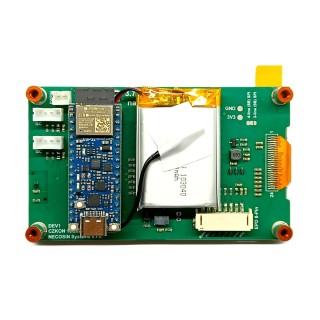
ESP32 nanoPower - Ultra-Low Power Development Board with Battery Management
  • ESP32 nanoPower - Ultra-Low Power Development Board with Battery Management
  • ESP32 nanoPower - Ultra-Low Power Development Board with Battery Management
  • ESP32 nanoPower - Ultra-Low Power Development Board with Battery Management
  • ESP32 nanoPower - Ultra-Low Power Development Board with Battery Management
  • ESP32 nanoPower - Ultra-Low Power Development Board with Battery Management
  • ESP32 nanoPower - Ultra-Low Power Development Board with Battery Management
  • ESP32 nanoPower - Ultra-Low Power Development Board with Battery Management
  • ESP32 nanoPower - Ultra-Low Power Development Board with Battery Management
  • ESP32 nanoPower - Ultra-Low Power Development Board with Battery Management
  • ESP32 nanoPower - Ultra-Low Power Development Board with Battery Management

ESP32 nanoPower - Ultra-Low Power Development Board with Battery Management

Kč749.00
Delivered within 4 days
Battery Capacity: No Battery
Quantity

No shipping option or high shipping rates to your country? Feel free to contact us.

Meet the ESP32 nanoPower, the ultimate development board for your battery-powered IoT projects. Combining a powerful ESP32 with sophisticated deep-sleep and Li-Po battery management, it's designed to run for weeks or months on a single charge. Perfect for remote sensors and portable devices.

Power Your Ideas, For Longer.

Stop worrying about battery life and start building smarter, longer-lasting IoT devices. The ESP32 nanoPower is an all-in-one solution engineered from the ground up for extreme power efficiency. At its heart is a powerful ESP32-PICO-MINI-02 with Wi-Fi and Bluetooth, giving you the connectivity and processing power you need for any project.

Intelligent Battery Management

We've integrated a complete Li-Po battery management system. Simply connect your battery to the JST connector and use the USB-C port to charge it safely, with temperature protection via the included NTC thermistor. The board's deep-sleep capabilities allow the ESP32 to wake up, perform a task, and go back to sleep, consuming mere microamps of current.

The battery charger is configured to 0.35A (defined by a resistor value).

Typical power consumption in ESP32 Deep Sleep with the main 3.3V switching regulator enabled is 220uA.

Ready for Your Project

Whether you're building a remote weather station, a GPS tracker, a smart home sensor, or a custom wearable device, the ESP32 nanoPower provides the robust and reliable foundation you need. Our straightforward C++ API makes it easy to read battery voltage, control peripherals, and manage power states, letting you focus on your application logic.

Key Features:

  • Powerful ESP32-PICO-MINI-02 with 8MB Flash and 2MB PSRAM
  • Advanced Power Management with Ultra-Low Deep Sleep Current
  • Integrated Li-Po/Li-Ion Battery Charger with NTC temperature monitoring
  • Onboard Buck-Boost converter provides a stable 3.3V supply from any source
  • USB-C for programming, power, and charging
  • Simple C++ (Arduino IDE) API for easy control of all hardware features

Available Variants:

  • Bare nanoPower board (Unsoldered): The board itself with unsoldered header pins.
  • Bare nanoPower board (Soldered): The board with headers pre-soldered for your convenience.
  • nanoPower 50mAh Li-Pol Set: The board with a 50mAh battery and integrated NTC thermistor.
  • nanoPower 80mAh Li-Pol Set: The board with a larger 80mAh battery and integrated NTC thermistor.
  • nanoPower 1200mAh DIY Set: The board with a 1200mAh battery and a separate NTC thermistor on a wire.
D20032

Data sheet

Our Promise
Expert Technical Support from Developers

Specific References

MPN
D20032

Here you find additional resources such as API, Example Source code etc.

Download the ESP32 nanoPower API (Arduino IDE Header File):

Use this API to access the device features in Arduino IDE.

nanoPower_api.h

Download the stock demo source code:

Use this source file to test the nanoPower API and build your Application easily.

ESP32_nanoPower_DemoCode.ino